

Across Italy and the DACH region, food manufacturers are facing the same reality:
 Increasing production demand
- Labor shortages and rising costs
- End-of-line processes limiting throughput
 Increasing production demand
 Labor shortages and rising costs
 End-of-line processes limiting throughput
And more often than not, the bottleneck isn’t where you think.
 It’s palletizing.
The challenge: Scaling without hiring
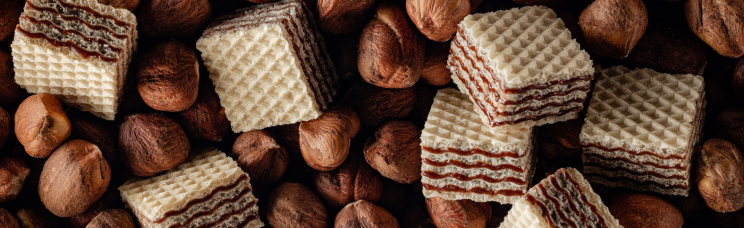
A premium Italian manufacturer of chocolate, pastries, and snacks recently faced this exact situation.
Their setup was simple — but limiting:
- 1 operator per palletizing station
- €40,000/year labor cost
- 1 shift, 1 line
Scaling production meant only one thing: Hiring more operators
But in today’s labor market, that’s:
- Expensive
- Unreliable
- Hard to sustain long-term
So they asked a better question:
“How can we increase output without increasing labor?”
The application: typical (and challenging) food industry constraints
This wasn’t a niche use case. It’s exactly what many manufacturers deal with daily:
- Cardboard boxes up to 17 kg
- 6–10 picks per minute
- Pallets up to 1,700 mm
- Interlayers required
- Boxes arriving via conveyor, consistently oriented
 Cardboard boxes up to 17 kg
 6–10 picks per minute
 Pallets up to 1,700 mm
 Interlayers required
 Boxes arriving via conveyor, consistently oriented
In other words:
Too demanding for manual scaling But traditionally seen as too complex for flexible automation
The solution: Robotiq Lean Palletizing (PE20 model)
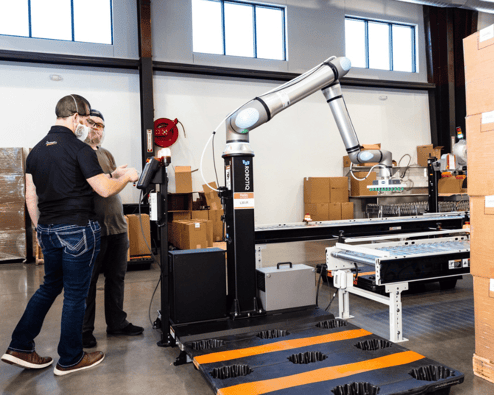
Instead of going with a rigid, high-cost automation system, the manufacturer selected:
Robotiq PE20
Because it’s designed specifically for manufacturers who need:
Fast deployment
 Fast deployment
No major layout changes. No long integration cycles.
Safe collaboration
Operate without fencing — ideal for existing production environments.
flexibility
Handle multiple SKUs, box sizes, and pallet patterns without re-engineering.
Ease of use
Operators can run the system without robotics expertise.
The results: Immediate ROI and scalable growth
€40,000 saved per year — per station
 €40,000 saved per year — per station
By removing one manual palletizing role:
- Labor costs dropped instantly
- Payback became highly predictable
Increased throughput
With a stable pick rate of 6–10 picks/min:
- No more end-of-line bottlenecks
- Production can scale with confidence
Better pallet quality
- Consistent stacking
- Integrated interlayer handling
- Reduced product damage
Future-proof operations
As production evolves:
- New products? No problem
- New formats? Easily configurable
- New demands? Already covered
Why this matters for Italian & DACH manufacturers
If you’re running a food production line in:
 Italy
Italy Germany
 Austria
 Switzerland
You’re likely dealing with:
- High labor costs
- Workforce shortages
- Pressure to increase efficiency
The reality:
Manual palletizing doesn’t scale anymore.
The opportunity:
Automation doesn’t have to be complex or risky.
The smartest first step in automation
Many manufacturers think they need to automate entire lines.
But in reality:
Palletizing is often the fastest, lowest-risk entry point into automation
- Quick ROI
- Minimal disruption
- Immediate impact
Is your application a good fit?
Not every palletizing setup is the same.
The real question is:
Will this work for your boxes, your rates, your layout?
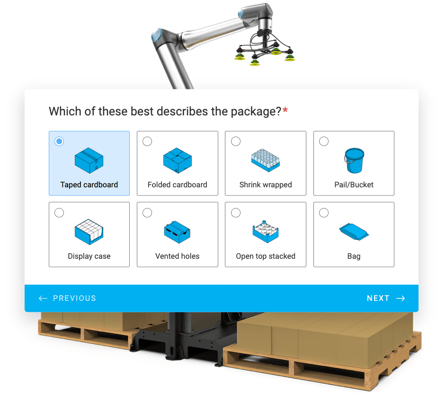
Try the Palletizing Fit Tool (2 Minutes)
Get a clear answer instantly:
- Check if your application is compatible
- Estimate ROI based on your inputs
- Get a recommended configuration
 Check if your application is compatible
 Start your evaluation now with the Palletizing Fit Tool

The post How food manufacturers in Europe are automating palletizing without adding headcount first appeared on TechToday.
This post originally appeared on TechToday.